
Monday, 17 March 2008
Darker Than the Deepest Sea: The Search for Nick Drake
Nick had also begun to sing a song he'd learned from a fellow French language student in Aix. Guitarist and singer Robin Frederick was a 19-year-old from Miami Florida via Southern California, who performed a mixture of folk standards and some original compositions in the cabaret club where foreign students gathered. Writing in Mojo magazine nearly a quarter of a century later, she recalled how Nick had introduced himself one evening after a gig and asked if she would care to get together to play some songs. From then on Nick would appear regularly at Robin's flat and the two would while away the night playing guitar. Robin Frederick doesn't remember Nick playing any of his own songs either, just covers. She does recall him enjoying Changes by Phil Ochs and detects traces of it in Nick's own compositions, which she didn't hear until many years after his death.

Theo: The Autobiography of Theodore Bikel
Back in the sixties, there were several major songwriters who dealt specifically with political events. One was Tom Paxton, who still continues to be extraordinarily productive, albeit not exclusively in the broadside vein. Another was a young man named Phil Ochs. Phil's pain from what he read and saw resulted in a prolific flow of lyrics from his pen and of music from his guitar. He would come to my apartment and sing for me his latest songs. I was often struck by the thought that he could not possibly keep on with these raw feelings without psychologically coming to grief. Little did I know that he would come to even greater harm than that. Occasionally I would sing his songs to people who were not familiar with Phil Ochs and the songs made quite an impact. One time I was a guest in Senator Gaylord Nelson's house in Maryland when Hubert Humphrey came to visit. I decided to sing Phil's song "I Ain't Marchin' Anymore" and wondered how the guests would take it. They applauded heartily, but I also saw some disturbed looks in their eyes, as though I had broached a subject that might better have been avoided in polite society.
With time Phil Ochs became embittered. Perhaps one should have had an inkling of what was going through his mind when, sometime around 1964, with John Kennedy dead and buried, he said to Bob Dylan, "Politics, it's all bullshit, man. That's all it is. If somebody was to tell the truth, they're gonna be killed."* Phil Ochs was a man who had dreams and a vision of a just society. Then he gave up on the dream and went and took his own life. He was right to have had the dream: How tragic that he lost it.
[*Bikel erroneously attributes this quotation to Ochs; in fact, Dylan said similar words to Ochs, as Ochs related in his 1968 Broadside interview.]
With time Phil Ochs became embittered. Perhaps one should have had an inkling of what was going through his mind when, sometime around 1964, with John Kennedy dead and buried, he said to Bob Dylan, "Politics, it's all bullshit, man. That's all it is. If somebody was to tell the truth, they're gonna be killed."* Phil Ochs was a man who had dreams and a vision of a just society. Then he gave up on the dream and went and took his own life. He was right to have had the dream: How tragic that he lost it.
[*Bikel erroneously attributes this quotation to Ochs; in fact, Dylan said similar words to Ochs, as Ochs related in his 1968 Broadside interview.]
Thursday, 13 March 2008
'Chicago 10' offers compelling footage, but its revisionism can be distracting
By BILL WHITE
SPECIAL TO THE P-I
 In August 1968, thousands of anti-war protesters went to Chicago to celebrate a Festival of Life as a counter-activity to the Democratic National Convention. The city's refusal to grant the necessary permits for this gathering resulted in protests, and in violent attacks on the protesters by police.
Following the August riots, eight defendants were tried for conspiring to cross state lines with the intent to create various disturbances in the city. With Black Panther Bobby Seale separated from the rest of the group and tried individually, these defendants became known as The Chicago 7.
Now, 40 years later, documentarian Brett Morgan ("The Kid Stays in the Picture") has made a film called "Chicago 10," restoring Seale to the mix, and adding defense attorneys William Kunstler and Leonard Weinglass, apparently because they received sentences for contempt.
Making the seven into 10 is only the beginning of Morgan's revisionism in his transformation of history into what might be called speculative allegory.
Music, an essential ingredient of the '60s revolution, is the first thing Morgan changes. We see the MC5 performing in the park, but it is Rage Against the Machine that we hear. In another scene, police escort a group of protesters from a rally to the accompaniment of rap music. Morgan may imagine that by changing the soundtrack he is making the events relevant to young people today, but it is a transparent sleight of hand that is unlikely to fool anybody.
What makes "Chicago 10" an important film, however, is the wealth of visual material Morgan has collected. Images from the Chicago riots have been used in earlier films, most notably Haskell Wexler's "Medium Cool," but never has such an enormous amount of footage from so many diverse sources been available in one place.
Morgan's decision to animate the trial segments is justifiable: Cameras were forbidden in the courtroom. The animation is preferable to out-and-out dramatization, which would have conflicted with the accompanying footage of real people outside the courthouse. The actors performing the voiceovers -- particularly Roy Scheider as Judge Hoffman -- do justice to the original tones and cadences of the trial transcripts.
There is plenty in "Chicago 10" to annoy those who lived through the period. The content selected for the courtroom scenes serves only to accentuate the outrageousness of the trial. (For example, Allen Ginsberg recited several poems during his testimony for the defense, but the one chosen for the film is an erotic poem having nothing to do with his participation in the protest.) Other witnesses are noticeably absent -- such as Phil Ochs, who had more to do with the planning of the protest than some of the defendants.
On other occasions, the film veers from the time frame of the convention and its aftermath to include such parenthetical material as Mayor Richard Daley's order to shoot all looters on sight during the riots following Martin Luther King's assassination. Morgan probably is suggesting a precedent to Daley's use of blind force in response to public chaos, but he does not make it clear that such an insinuation is intentional.
Yet there are many moments of historical force here, such as a clip of Walter Cronkite declaring "the Democratic Convention is about to begin in a police state." With its scenes of tear gas rolling into Lincoln Park accompanied by the cries of a random victim of police brutality desperately singing "We Shall Overcome" as she is forcefully shoved into a police wagon, "Chicago 10" is a timely reminder that dissident youth once were viewed by the government as enemies of the state. In 1968, as the cameras rolled, one of the slogans echoing through the brutalized crowds was "the whole world is watching." Morgan's collection of these images forces us to keep watching, and recognize this as part of our very recent history.
It also is a reminder of a line from one of the many songs Ochs wrote in response to the events of Chicago: "They teach you in the classroom that it can't happen here. But it has happened here."
SPECIAL TO THE P-I
 In August 1968, thousands of anti-war protesters went to Chicago to celebrate a Festival of Life as a counter-activity to the Democratic National Convention. The city's refusal to grant the necessary permits for this gathering resulted in protests, and in violent attacks on the protesters by police.
Following the August riots, eight defendants were tried for conspiring to cross state lines with the intent to create various disturbances in the city. With Black Panther Bobby Seale separated from the rest of the group and tried individually, these defendants became known as The Chicago 7.
Now, 40 years later, documentarian Brett Morgan ("The Kid Stays in the Picture") has made a film called "Chicago 10," restoring Seale to the mix, and adding defense attorneys William Kunstler and Leonard Weinglass, apparently because they received sentences for contempt.
Making the seven into 10 is only the beginning of Morgan's revisionism in his transformation of history into what might be called speculative allegory.
Music, an essential ingredient of the '60s revolution, is the first thing Morgan changes. We see the MC5 performing in the park, but it is Rage Against the Machine that we hear. In another scene, police escort a group of protesters from a rally to the accompaniment of rap music. Morgan may imagine that by changing the soundtrack he is making the events relevant to young people today, but it is a transparent sleight of hand that is unlikely to fool anybody.
What makes "Chicago 10" an important film, however, is the wealth of visual material Morgan has collected. Images from the Chicago riots have been used in earlier films, most notably Haskell Wexler's "Medium Cool," but never has such an enormous amount of footage from so many diverse sources been available in one place.
Morgan's decision to animate the trial segments is justifiable: Cameras were forbidden in the courtroom. The animation is preferable to out-and-out dramatization, which would have conflicted with the accompanying footage of real people outside the courthouse. The actors performing the voiceovers -- particularly Roy Scheider as Judge Hoffman -- do justice to the original tones and cadences of the trial transcripts.
There is plenty in "Chicago 10" to annoy those who lived through the period. The content selected for the courtroom scenes serves only to accentuate the outrageousness of the trial. (For example, Allen Ginsberg recited several poems during his testimony for the defense, but the one chosen for the film is an erotic poem having nothing to do with his participation in the protest.) Other witnesses are noticeably absent -- such as Phil Ochs, who had more to do with the planning of the protest than some of the defendants.
On other occasions, the film veers from the time frame of the convention and its aftermath to include such parenthetical material as Mayor Richard Daley's order to shoot all looters on sight during the riots following Martin Luther King's assassination. Morgan probably is suggesting a precedent to Daley's use of blind force in response to public chaos, but he does not make it clear that such an insinuation is intentional.
Yet there are many moments of historical force here, such as a clip of Walter Cronkite declaring "the Democratic Convention is about to begin in a police state." With its scenes of tear gas rolling into Lincoln Park accompanied by the cries of a random victim of police brutality desperately singing "We Shall Overcome" as she is forcefully shoved into a police wagon, "Chicago 10" is a timely reminder that dissident youth once were viewed by the government as enemies of the state. In 1968, as the cameras rolled, one of the slogans echoing through the brutalized crowds was "the whole world is watching." Morgan's collection of these images forces us to keep watching, and recognize this as part of our very recent history.
It also is a reminder of a line from one of the many songs Ochs wrote in response to the events of Chicago: "They teach you in the classroom that it can't happen here. But it has happened here."
Saturday, 8 March 2008
Conversation with U.S. Student Ifshin Reported
 [Interview with National Committee Member of the Association of American Students David Ifshin; Montevideo, Uruguay, El Popular, Spanish, 15 October 1971, p 2]
Hours before the government, in one more demonstration of its hatred of liberties and its scorn for rights and constitutional rules, expelled him from the country (the only Americans acceptable in the eyes of the government are inspectors from the IMF or agents of the CIA), we had the opportunity to chat with David Ifshin, former president of the National Association of American Students (grouping student associations of 500 of the 800 universities in his country), who visited Uruguay after participating in the Congress of Solidarity with Vietnam, which was organized in Santiago, Chile by the IUS and the WFDY. Ifshin, who has visited the Democratic Republic of Vietnam and who currently belongs to the national committee of the Association of American Students, participated at Santiago as an observer for the association.
Question: What are the most important characteristics of the American student movement?
Answer: Until now, the student movement has centered its efforts especially on the struggle against the war in Vietnam and for integration of the black people. Another subject which mobilizes American students is the question of university reform.
Question: What do students demands concerning the reform consist of?
Answer: It is being demanded that the existing competitive system in the universities for achieving better qualifications and better positions be done away with. This is the present system, and it represents an application of the success theory to the university environment. This theory was very important as a factor for mobilization. But it was understood that what is behind this system is the capitalist structure, which finds expression through competition, as in racial discrimination or in the war in Vietnam. Developments in the struggles have brought the students and the black population to understand that the struggle for partial objectives has no future and that it is a question of involving the entire social and economic structure. One of the important elements in helping to clarify the issue was the slaughter at Attica.
Question: Was this reflected in the movement?
Answer: There is one chief contradiction within the students' and people's movement. Having a greater awareness of what the real problem behind each of these expressions is, and beginning to face up to a general questioning of the capitalist structure, there still exist sectors which center their struggle around a particular demand -- some for improvements, others for women's rights, others for the war in Vietnam, and others for university reform. This means that despite a growing awareness of the total problem, difficulties which hold back the development of the movement remain due to this attention to partial demands.
Question: How is this problem met?
Answer: The struggle against the war in Vietnam has been taken at the center, and through this an attempt is made to unify the movement. Last spring one of the largest demonstrations for putting a stop to the war in Vietnam took place. Even the reactionary American press admitted that more than half a million persons took part in this demonstration. Students, workers, union leaders, and even important personalities, congressmen, and senators took part. It was called by the National Action Coalition for Peace and the People's Coalition for Peace and Justice, which not only called for the demonstration, but also for the application of civil disobedience measures. I mention in passing that the association of students belongs to both coalitions.
At the head of the demonstration was the Truckers' Union, one of the largest in the country, which takes part in demonstrations against the war in Vietnam, as well as many other unions. In addition -- and for the first time -- veterans of the Vietnam War, in uniform, took part in the demonstration for 5 days, opposing the government and the Supreme Court. This is the first time in the history of the United States that war veterans have participated against a war that was still going on. This protest demonstration continued for a week and was headlined nationally. The Supreme Court order the veterans to withdraw. They refused, and Nixon did not feel encouraged to give the police a public order to throw them out by force, although that was the order requested. There was one point at which the police refused to repress the veterans. For that reason -- because that atmosphere existed -- Nixon did not have the courage to give a public order for them to be thrown out. The veterans camped at night in a park near the Supreme Court. This demonstration took place in Washington. Many of the veterans who took part in it had been crippled in the war.
Even the reactionary press commented in its headlines that the war veterans disregarded the Supreme Court. Many of these veterans appeared voluntarily to accuse themselves as war criminals for having been in Vietnam.
It is becoming understood more and more that the war in Vietnam is not an isolated problem, but only the most severe and the most concrete example of American imperialism: something that can happen in Vietnam, as in Bolivia, Uruguay, or another part of the world.
Question: Particularly, in Latin America...?
Answer: Especially at this time, the subject of Latin America is entering a crucial period, according to [copy unclear; possibly intended to read: as is understandable]. The U.S. Government has not defined a policy for Latin America because it finds no way in which to explain it to the American people. The movement is trying to create awareness, so that people will understand the imperialist maneuver before action takes place and not afterward, as happened in Vietnam.
I think that the conditions are being created and that we are arriving at a point at which it will be possible to restrain aggression, for example, of the Santo Domingo type. Nixon is keeping the U.S. policy more and more a secret and deceiving the American people, because the people's movement is becoming a force capable of checking aggression. The government is going to have to think twice before carrying out an attack or an invasion. Even the U.S. military power has been broken. The Army wants to get out of Vietnam, despite the fact that 10 years ago it wanted to go into Vietnam. It must be said that the morale of the soldiers in Vietnam has hit bottom. More than 20 percent of the soldiers are drug addicts. Of course, Nixon lies to the people. He is trying to sue not soldiers, but mechanized warfare: bombing raids, for example, in order to avoid casualties and the participation of soldiers in combat. He thinks that he can keep the war more or less secret, to the extent that there are no dead soldiers. Our work is directed toward making people understand that the problem is not one of dead soldiers but of imperialist aggression.
Question: What is the government doing about the movement?
Answer: Nixon responds on many levels. The first thing was to say that the movement was violent, irresponsible, and controlled by foreign powers; that is, the use of anticommunism. But it is very easy to answer this, because all the violence of the movement cannot be compared to U.S. violence in 1 day of war in Vietnam. I must say that the attacks against the left have strengthened the left.
In addition, they have again had recourse to supposedly liberal methods, saying that the United States is a free country and that everyone can express himself as long as he is not violent, also that anyone who tries to do something is an extremist. They also accuse the leaders with criminal charges, as in the case of Angela Davis or Bobby Seale, one of the leaders of the Black Panthers, who was jailed with the other leaders, and who was released recently. They try to isolate the leaders of the movement in addition to attempting to frighten the movement.
They also make it necessary to divert forces, since the struggle to liberate the prisoners draws off forces, requires much effort, money, and so on.
Question: What do the American people think of Latin America?
Answer: The American people know very little about Latin America. They have been indoctrinated with false ideas. Many of my leftist friends did not understand why I was coming to Latin America. Only one sector of the left is really aware of what is happening in Latin America. For that reason I think it is very important to coordinate our forces and our movements in order to make more information available concerning what is happening. I think we have much to learn from Latin American experiments such as Popular Unity in Chile, the Broad Front in Uruguay, and the National Assembly of the Argentines. Many people in the United States think Latin America is limited to Bolivia, Cuba, and Mexico. I believe that the meeting in Chile was very important, but I think that more open contacts must be made in order to make better coordination easier.
--Transmitted by the CIA as part of Operation MHCHAOS
Tuesday, 26 February 2008
Hope keeps the weeds of cynicism from strangling democracy's flowers
By Nick Licata
Special to The Times
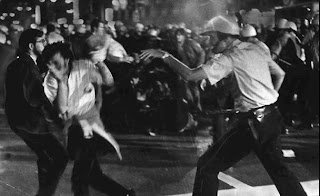 As the Democratic National Convention approaches, the one held 40 years ago in Chicago offers an insight into how the next election might turn out.
In 1968, the United States was embroiled in the unpopular Vietnam War, with hundreds of thousands of protesters marching in the streets. Today, the U.S. is stuck in the unpopular war in Iraq.
Although the number of protest marches is down, opinion polls show greater discontent with this war. It was not until after the 1968 election that a Gallup Poll revealed a slight majority of Americans favoring a withdrawal from Vietnam. Today, before the party's nominating conventions, three in five Americans (61 percent) think U.S. forces should get out of Iraq within a year.
Nevertheless, unlike the thousands of protesters battling police outside the Democrats' '68 national convention, there will be no mass protests at either party's convention, despite an ongoing war and an unpopular incumbent president.
There will be none for three obvious reasons. There is no draft and therefore college students, who formed the backbone of the Vietnam protests, do not have to think about trudging in a swampy jungle after trampling the trimmed lawns of their campuses. The number of soldiers in Iraq is a third of what we had deployed in Vietnam — 160,000 versus 500,000 — and that includes the latest "surge" of troops. Finally, this war's "embedded" media in our military limits opportunities to beam home images of civilian carnage and, thus, there is less anger and shock than accompanied the gritty Vietnam War photos from more independent journalists.
But, most important, there is another reason: cynicism has not corrupted our spirit. In '68, there was a growing sense of cynicism, best expressed by the growing baby-boomer population, that fed the nation's anger and discouragement with politics. At the June 1968 national convention of the Students for a Democratic Society, the largest student organization to ever exist in the U.S., the predominant attitude was that the upcoming election was a fraud that would only foster the illusion of democracy. There was little hope that electoral politics could end the war.
The chance for hope was dashed when Democratic presidential candidate Robert Kennedy was assassinated a week before the SDS meeting. He was on the way to winning over the doubtful; even anti-war folk singer Phil Ochs, known for his cynical ballad "Love me, I'm a Liberal," was a Bobby Kennedy fan.
Today, that sense of hope is being expressed most visibly through the younger generation embracing another relatively neophyte politician, Sen. Barack Obama, to the chagrin of Sen. Hillary Rodham Clinton, who is as respectable a legislator as Sen. Hubert Humphrey was in '68.
Both Clinton and Humphrey have legislative track records that are significant and progressive. But fate dealt each a hand with an ace of spades, that killer card that portends doom despite its apparent value. In both of their cases, it's an ex- or soon-to-be-ex-president.
Humphrey, who was the strongest critic of the Vietnam War inside the Lyndon Johnson administration, had to keep his saber in his sheath during the campaign so as not to wound his commander-in-chief, who had chosen not to run for re-election. Clinton has to keep reminding everyone that she is not another Bill Clinton; she is truly a progressive in her own right.
Similar to Humphrey, she has a dominant ex-president as her closest and most public ally. And, in her eagerness for the ex-president's crown, she has muted her own potential for inspiring change in the way things are done in the nation's capital, as Humphrey did.
A replay of Humphrey's valiant but ultimate failure at the polls should cause a Democrat's heart to skip a beat. The question that many Democrats are asking themselves is, which ship can make it to shore this time?
The crowds, and their enthusiasm, point the way. Hope is what wins elections, not résumés, no matter how long or meritorious. Hope is what drives the voters to the polls. It's what keeps the weeds of cynicism from strangling democracy's flowers. It is why there will be no repeat of the '68 convention's roiling, mass demonstrations.
And, it is why the nominee who can capture the spirit of that hope will reach the shore next fall.
Nick Licata is a member of the Seattle City Council and a former chapter president of Students for a Democratic Society at Bowling Green State University.
Special to The Times
 As the Democratic National Convention approaches, the one held 40 years ago in Chicago offers an insight into how the next election might turn out.
In 1968, the United States was embroiled in the unpopular Vietnam War, with hundreds of thousands of protesters marching in the streets. Today, the U.S. is stuck in the unpopular war in Iraq.
Although the number of protest marches is down, opinion polls show greater discontent with this war. It was not until after the 1968 election that a Gallup Poll revealed a slight majority of Americans favoring a withdrawal from Vietnam. Today, before the party's nominating conventions, three in five Americans (61 percent) think U.S. forces should get out of Iraq within a year.
Nevertheless, unlike the thousands of protesters battling police outside the Democrats' '68 national convention, there will be no mass protests at either party's convention, despite an ongoing war and an unpopular incumbent president.
There will be none for three obvious reasons. There is no draft and therefore college students, who formed the backbone of the Vietnam protests, do not have to think about trudging in a swampy jungle after trampling the trimmed lawns of their campuses. The number of soldiers in Iraq is a third of what we had deployed in Vietnam — 160,000 versus 500,000 — and that includes the latest "surge" of troops. Finally, this war's "embedded" media in our military limits opportunities to beam home images of civilian carnage and, thus, there is less anger and shock than accompanied the gritty Vietnam War photos from more independent journalists.
But, most important, there is another reason: cynicism has not corrupted our spirit. In '68, there was a growing sense of cynicism, best expressed by the growing baby-boomer population, that fed the nation's anger and discouragement with politics. At the June 1968 national convention of the Students for a Democratic Society, the largest student organization to ever exist in the U.S., the predominant attitude was that the upcoming election was a fraud that would only foster the illusion of democracy. There was little hope that electoral politics could end the war.
The chance for hope was dashed when Democratic presidential candidate Robert Kennedy was assassinated a week before the SDS meeting. He was on the way to winning over the doubtful; even anti-war folk singer Phil Ochs, known for his cynical ballad "Love me, I'm a Liberal," was a Bobby Kennedy fan.
Today, that sense of hope is being expressed most visibly through the younger generation embracing another relatively neophyte politician, Sen. Barack Obama, to the chagrin of Sen. Hillary Rodham Clinton, who is as respectable a legislator as Sen. Hubert Humphrey was in '68.
Both Clinton and Humphrey have legislative track records that are significant and progressive. But fate dealt each a hand with an ace of spades, that killer card that portends doom despite its apparent value. In both of their cases, it's an ex- or soon-to-be-ex-president.
Humphrey, who was the strongest critic of the Vietnam War inside the Lyndon Johnson administration, had to keep his saber in his sheath during the campaign so as not to wound his commander-in-chief, who had chosen not to run for re-election. Clinton has to keep reminding everyone that she is not another Bill Clinton; she is truly a progressive in her own right.
Similar to Humphrey, she has a dominant ex-president as her closest and most public ally. And, in her eagerness for the ex-president's crown, she has muted her own potential for inspiring change in the way things are done in the nation's capital, as Humphrey did.
A replay of Humphrey's valiant but ultimate failure at the polls should cause a Democrat's heart to skip a beat. The question that many Democrats are asking themselves is, which ship can make it to shore this time?
The crowds, and their enthusiasm, point the way. Hope is what wins elections, not résumés, no matter how long or meritorious. Hope is what drives the voters to the polls. It's what keeps the weeds of cynicism from strangling democracy's flowers. It is why there will be no repeat of the '68 convention's roiling, mass demonstrations.
And, it is why the nominee who can capture the spirit of that hope will reach the shore next fall.
Nick Licata is a member of the Seattle City Council and a former chapter president of Students for a Democratic Society at Bowling Green State University.
Anti-war music event planned next week in Burlington
BURLINGTON -- The Peace & Justice Center in Burlington will present an evening of anti-war music, past and present, at 7 p.m. on March 7 at City Hall's Contois Auditorium.
The event - "I Ain't Marching Anymore," a Phil Ochs Song Night - marks five years of the occupation of Iraq. It is meant to pull the Vietnam War and Iraq War protest music into one show. Vermont musicians will be performing one Phil Ochs song and one original song.
Phil Ochs is widely known for writing and performing protest music during the Vietnam War 40 years ago. Och's song titles include "Draft Dodger Rag," "Cops of the World" and "Is there Anybody Here." At the time of his death in 1976, Ochs had written over 100 songs.
The show will feature performances by musicians that span generations. Some of the older performers have experienced both the Vietnam War and the Iraq War. The younger performers have the experience of the Gulf, Afghanistan and Iraq Wars.
Performers include Amber deLaurentis & Tom Cleary, Jon Gailmor, The Magnolias, Colin Clary, Rik Palieri, Hannah Pitkin & Max Bronstein-Partiz of the Limes, and a rare Chittenden County appearance by Vermont's folk singing Senator Dick McCormack.
The concert is a benefit for the Peace & Justice Center's Recruiting for Peace Campaign. Tickets: $20, $15 for age 12 and under. Purchase tickets at the Peace & Justice Center, 863-2345 x2, or the Flynn Box Office.
The event - "I Ain't Marching Anymore," a Phil Ochs Song Night - marks five years of the occupation of Iraq. It is meant to pull the Vietnam War and Iraq War protest music into one show. Vermont musicians will be performing one Phil Ochs song and one original song.
Phil Ochs is widely known for writing and performing protest music during the Vietnam War 40 years ago. Och's song titles include "Draft Dodger Rag," "Cops of the World" and "Is there Anybody Here." At the time of his death in 1976, Ochs had written over 100 songs.
The show will feature performances by musicians that span generations. Some of the older performers have experienced both the Vietnam War and the Iraq War. The younger performers have the experience of the Gulf, Afghanistan and Iraq Wars.
Performers include Amber deLaurentis & Tom Cleary, Jon Gailmor, The Magnolias, Colin Clary, Rik Palieri, Hannah Pitkin & Max Bronstein-Partiz of the Limes, and a rare Chittenden County appearance by Vermont's folk singing Senator Dick McCormack.
The concert is a benefit for the Peace & Justice Center's Recruiting for Peace Campaign. Tickets: $20, $15 for age 12 and under. Purchase tickets at the Peace & Justice Center, 863-2345 x2, or the Flynn Box Office.
Friday, 22 February 2008
Reclaiming a gallant voice
 By Adrian Walker
Globe Columnist / February 22, 2008
William Worthy reported from Communist China, the Shah's Iran, and Cuba in the early days of Fidel Castro.
He aroused the ire of the State Department by defying travel bans in the 1950s and 1960s and slipping into nations that were off-limits to Americans.
He was the subject of a famous Phil Ochs folk song, "The Ballad of William Worthy" that celebrated his exploits.
And now this journalism legend, born and raised in one of Roxbury's most prominent families, sits nearly forgotten in an assisted-living facility in Hyde Park. At 86, he is in the early stages of Alzheimer's disease.
One of Worthy's fondest memories and professional highlights was his time as a Nieman Fellow at Harvard University, class of 1957. The Nieman Foundation will honor him today with the prestigious Louis M. Lyons Award, named after the program's longtime curator.
"The award is given to a journalist who represents the spirit of conscience and integrity that Louis stood for in his life and career," the current curator, Robert Giles, told me. "We're going to make this a real celebration of Bill's life and career."
The honor is overdue. But it won't do enough to rescue Worthy from his undeserved obscurity.
When I visited recently, he wasn't able to describe his exploits in detail, but many others have been happy to do it for him.
Worthy was a reporter for the Baltimore Afro-American newspaper and a contributor to CBS News beginning shortly after World War II, when blacks were scarce in mass media. An early patron was Edward R. Murrow, the legendary newsman, who encouraged him to pursue a career in radio and then television.
Worthy was always drawn to left-wing causes, and much of his best-known reporting was from Communist-bloc countries.
Worthy combined activism and journalism in a way that would be more difficult today. His political activism began in his early 20s. Worthy refused to fight in World War II, becoming a conscientious objector. "There was no way I could kill another human being," he told me. He was a Freedom Rider in the early days of the civil rights movement and a friend of Malcolm X.
All of this was a departure from the genteel circumstances in which he had been raised. When Worthy entered college, he was expected to follow in the footsteps of his father, a well-known obstetrician. But he discovered that his passion and his talents lay elsewhere.
Worthy's reporting career wound down in the early 1980s. He taught journalism at Boston University, where he clashed with president John R. Silber, and inaugurated a course in media criticism at the University of Massachusetts at Boston. He retired from a post at Howard University a few years ago.
After that, he disappeared from view for a while. Michael Lindsey, who taught the media course with Worthy at UMass and greatly admired him, realized last year that he had lost track of his old friend. He tracked him down at the Park Place center in Hyde Park. He discovered that Worthy's money was gone and that he had fallen on hard times.
How he came to be destitute is, at this point, something of a mystery. An appeal by Councilor Chuck Turner has led to the involvement of the city's Law Department, which is working to save Worthy's family home from creditors. There is a trove of Worthy's papers in the home. Dorothy Joyce, a spokeswoman for Mayor Thomas M. Menino, said yesterday that the city hopes that some of Worthy's papers will be placed at the Boston Public Library.
And today, while he is still able to appreciate the moment, he will be honored by the Nieman Foundation. Even as more recent memories have faded, he talks about his year at Harvard with glee.
With its relentless emphasis on the here and now, journalism doesn't do an especially good job of remembering its history. But William Worthy is part of it, reclaimed just in time.
Adrian Walker is a Globe columnist.
Subscribe to:
Posts (Atom)